
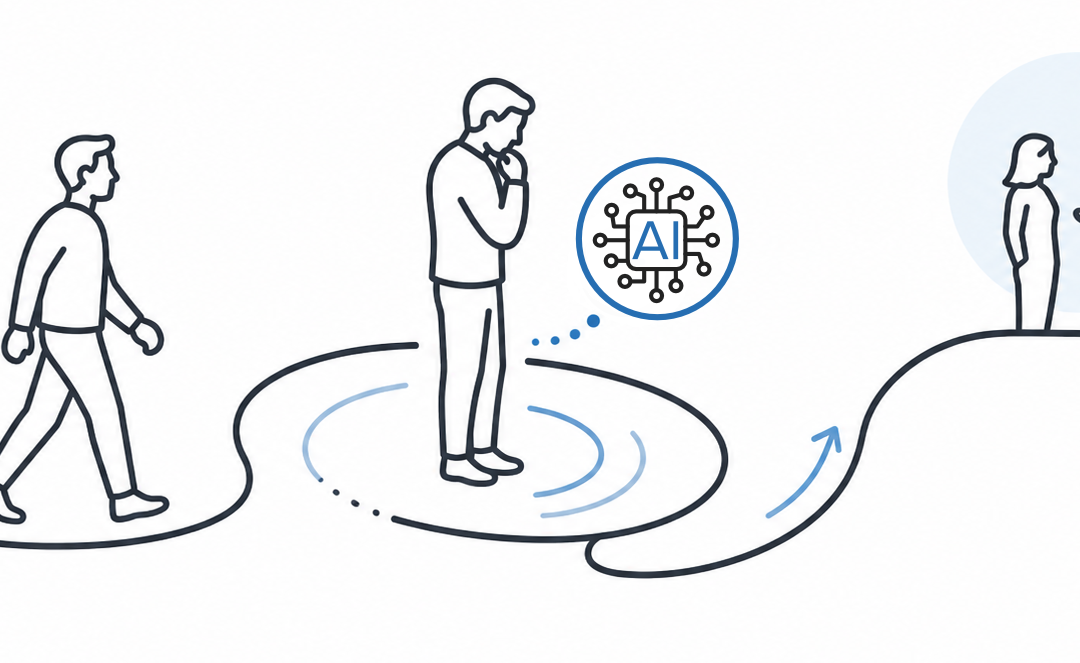
In many companies, AI is still mostly considered from the point of view of enhancing efficiency and productivity. Yet, the most exciting contribution of AI is often overlooked – that of mobilising minds and improving learning. This is the aspect we are focussing on at TalentMiles
AI is useful because it helps us save time and effort, and because it can do some of the routine things that we struggle with. For this reason, it is tempting to look for ways to engage AI also in the process of learning. But the challenge is that learning is the one place where putting in the effort matters. If AI gives you the answers and saves you the work of thinking, it is like going to the gym and having a robot lift the weights for you. You are missing the point. Science calls this **cognitive offloading**, using tools to reduce mental effort. It can be really useful, but not when the mental effort is what creates the learning. This is where using AI *in a different way* really creates a great opportunity: to protect the effort by slowing down the learner, adding the aspect of reflection, and asking the questions the learner would otherwise skip.
In this post, I will explore three practical questions related to AI and learning:
- Why is reflection the place where learning happens?
- How can AI support reflection in practice?
- What must we remember when using AI for learning?
Today, we have access to a great number of documents intended as learning material, and it is relatively easy to make that material available within companies. This, however, is only the first step. Reading the material gives the learner information and a framework; yet, the most impactful learning comes from experience. Well-designed learning activities create meaningful experiences of trying out new ways of working. After this, the experience still needs one more element to become an effective process of learning: reflection. Reflection is the step that turns experience into learning. This also aligns with what learning science calls generative learning: the learner has to do the sense-making work. The challenge is that reflection is also the step that is easiest to skip or to do poorly.
Three rules of thumb:
- Make reflection a distinct step in the flow.
- Keep it coaching-style: ask, listen, then follow up.
- Don’t let AI do the thinking for you!
This is how we approach learning with AI at TalentMiles. In our learning programmes, AI engages participants in a coaching dialogue, prompting them to slow down and reflect on the experience they just had. Instead of having an AI write the answers, the AI asks questions to help the participant think through what they have learned. Because the AI adapts to the participant’s responses, it can ask follow-up questions that help the participant dig deeper in a way that a static form cannot.
In a TalentMiles learning programme, reflection and learning are facilitated with the help of AI by implementing the TalentMiles app. In the app, the participant finds a task, which gives them an activity to be completed IRL. Once they have completed the activity, they return to the app. Before they can submit their answers, they first have to engage in a dialogue with an AI that asks them coaching questions and encourages them to pause and think about the activity they just completed. For example, a participant may have tried a new approach to giving feedback and then reflects on the experience with the AI. The AI might start by asking: “What did you notice about your colleague’s response?” If the participant says that the colleague became defensive, the AI might follow up with: “What was happening in the conversation just before that?” After this dialogue, the participant can proceed to submit their answers to the task.
It is important to note that the AI does not replace the learning coach. The coach still shapes the reflection for each task by setting the focus and tone, and the AI carries that out as a coaching dialogue in the moment. The participant’s answers for the task are still submitted to a learning coach, and the learning process is supervised by the coach, not by AI.
The speedbump created by the AI element between performing the activity and submitting the task helps to protect the moment of reflection. In today’s busy world, it is too easy to rush through and lose out on the learning available. Now, to be fair, this system cannot force the participant to take full advantage of the opportunity provided. No tool can make someone reflect deeply. The AI can only prompt and encourage and make it harder to skip the moment entirely.
Reflecting with AI scales well. The AI can provide every participant with a coaching dialogue whenever it fits their schedule, no matter how many participants there are on the programme. This reflection step can improve learning within tasks and increase the overall impact of the programme. For the participant, it provides a calm bridge between “doing the task” and “answering the questions”. This lets them take a moment to make sense of what they just experienced. The secret to using AI in learning and development is that better questions beat more answers. What participants discover through reflection changes what they believe, and what they believe changes what they do. When this happens across many participants, individual learning can begin to change how the organisation works.