
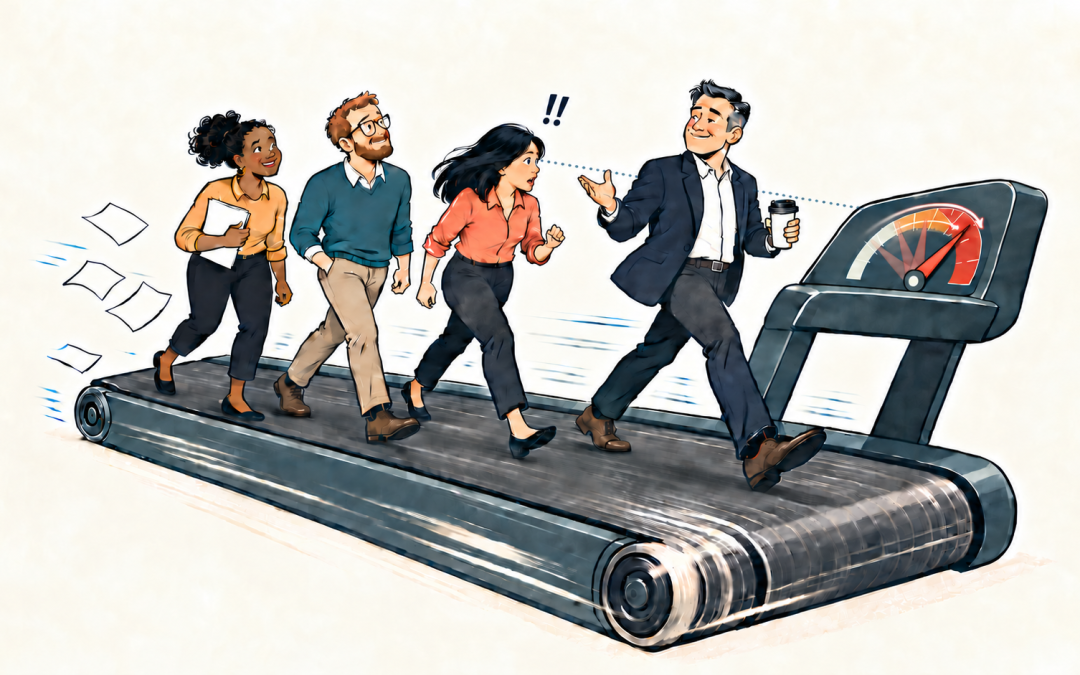
“Change is speeding up” is a refrain you hear frequently in organisations around the world. It is conventional wisdom and something organisations are all used to dealing with. The catch is that the claim is false. Change takes place and we all need to deal with it – but it is not true that change is something that is constantly accelerating.
One of the key drivers of the pace of change is technological development. This does not mean that every new technology accelerates change. Just keeping up the pace of change requires constant new technological developments. This makes the pace of change lumpy and uneven. The pace can stay constant, speed up, or slow down. Only rarely does a big technological revolution come about that causes a broad, economy-wide acceleration of change. Examples of these kinds of technologies are:
- Steam power in 1770–1780
- Electricity in 1880–1910
- Computing / ICT in 1970–1990
When these technological revolutions arrived, the pace of change was speeding up while the technology diffused. Then the pace of change settled down, possibly at a higher rate than before, but the acceleration came to an end.
The perception that change is accelerating still remains even when the pace of change stays constant. This is due to how we subjectively perceive time over long periods. We judge time spans in relation to our own lifespan. A change that takes ten years feels much slower to a twenty-year-old because for them it is half a lifetime, whereas a forty-year-old perceives the same ten-year change as only a quarter of a lifetime.
With AI we now stand on the precipice of another great acceleration in the pace of change, as with steam power, electricity and computing before. One thing makes AI different from the earlier technological revolutions: AI can also be used to help speed up the development of newer, more capable AIs. These improvements then accelerate AI development further, creating a self-reinforcing cycle. As these ever more capable AIs diffuse throughout the economy, they accelerate change far beyond AI itself. This is why AI is likely to bring even greater acceleration in the pace of change than earlier technological revolutions.
Leaders have built nimble and adaptive teams, and organisations have been able to handle the changes the world has thrown at them. The leaders believe that the changes their teams have been adapting to have been constantly accelerating. Based on that, they feel confident that their teams are up to handling an accelerating pace of change. But their past success does not show that they can keep adapting as the pace of change increases.
The arrival of AI means that there will be a substantial acceleration in the pace of change. The confidence of the leaders means that they believe their teams are equipped to handle such an acceleration. Thus, they underestimate what such an acceleration will demand from their organisations, and they are likely to be caught unprepared.
In our new, AI-driven world, organisations urgently need to strengthen their ability to learn and adapt. The TalentMiles approach of learning through questions, action and reflection helps organisations develop that capacity at scale by involving everyone in learning and adapting. What gives you confidence that your team can keep up when the pace of change really starts accelerating?